inquiry@tibettourism.com
 86-15728991588


.jpg)


If you yearn for pilgrimage, spiritual exploration, and the pristine beauty of the Himalayas, then planning a Charan Sparsh (touching the foot of Mount Kailash) at Mount Kailash would be an extraordinary experience. This article provides a comprehensive guide to understanding the meaning and significance of the Charan Sparsh and how to plan your Kailash trip, covering everything from timing and route selection to permits, health and fitness, equipment, and spiritual preparation. Whether you are an experienced trekker or a newcomer embarking on this sacred Kailash journey, this guide will help you prepare for one of the most meaningful experiences of your Tibet tour.
1. What Is Charan Sparsh?
The term Charan Sparsh comes from Sanskrit: Charan (foot) + Sparsh (touch) = “touching the foot”. In the context of Mount Kailash, Charan Sparsh refers to the act of touching the base or “foot” of the sacred mountain, which is regarded in Hinduism (and also revered in Buddhism, Jainism and Bon) as the abode of Lord Shiva.

In practice, when pilgrims perform Charan Sparsh, they symbolically bow to the mountain and simultaneously bow to the deity, expressing humility in their quest for blessings, purification, and spiritual renewal.
2. Why Visit Mount Kailash for Charan Sparsh?
Spiritual significance
(1) Mount Kailash is revered as the cosmic centre, the axis mundi, the place where heaven and earth meet in many traditional narratives.
(2) Touching the foot of the mountain is considered touching the feet of Shiva. Therefore, it is an act of profound reverence and surrender.
(3) Pilgrims believe that Charan Sparsh brings divine blessings, purifies past karma, and opens a new path to inner peace and spiritual growth.
Uniqueness of the experience
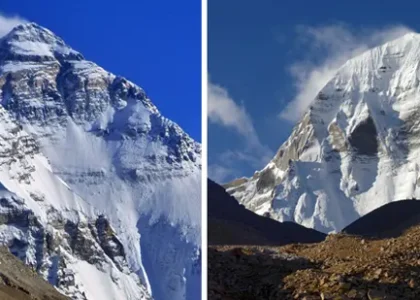
The Charan Spash trek is unique in its perfect blend of unspoiled natural beauty, profound cultural heritage, and deep personal reflection. Unlike many popular trekking routes that prioritize scenery, this pilgrimage leads you into a realm where spirituality and nature coexist in harmony. Standing before the majestic north face of Mount Kailash, surrounded by tranquility, grandeur, and unclimbed heights, you’ll experience a purity increasingly rare in today’s world. The scenery along the way changes dramatically, from emerald lakes to desolate mountain valleys, like a constantly evolving painting reflecting the pilgrim’s inner transformation. Every step is meaningful, every pause precious; the mountain’s tranquility, the high altitude, and the sacred energy guide you inward. This is a journey of both emotion and symbolism–a truly unique and irreplaceable experience.
3. When and Where to Do Charan Sparsh?
Best time to visit Mount Kailash
The best time for pilgrimage is from May to early October, when the weather is relatively stable, there is less snow, and transportation to Mount Kailash is easier. May and June hold special cultural and spiritual significance, as these two months coincide with Saga Dawa, one of Tibet’s most important Buddhist festivals. During Saga Dawa, local pilgrims gather to commemorate the Buddha’s birth, enlightenment, and parinirvana. Prayer flags flutter in the wind, and various ceremonies are held around Lake Manasarovar and Darchen, creating a profound religious atmosphere, making this an excellent time for pilgrimage to Mount Kailash.
From September to early October, the weather usually improves again, with clear skies, fresh air, and magnificent scenery, while the number of tourists is relatively smaller compared to the peak pilgrimage season.

In addition (late autumn and winter), pilgrims will face more severe weather, heavy snow, extremely low temperatures, limited transportation, and the closure of many accommodations, making the journey more challenging.
Route & Access for Mount Kailash Charan Sparsh
The pilgrimage typically begins in Darchen (also spelled Darchen or Dar Chhen) on the Tibetan side, from where the kora (circumambulation) of Mount Kailash begins.
To reach Darchen, you can choose to take the Tibetan route (starting from Lhasa) or the Nepalese route (via the Gyirong or Simikot border crossing), depending on your visa/permit.
The Charan Sparsh point is located on the northern slope of Mount Kailash. From Dirapuk at an altitude of 4700 m, the trek is about 7 km (about 3.5 km one way) on foot of Mount Kailash, with rugged terrain along the way.
4. A 4-Day Kailash Charan Sparsh Trek Itinerary
Below is a practical itinerary suitable for high-altitude areas, covering the traditional pilgrimage route as well as an extension of the sacred Charan Sparsh. This itinerary maximizes the spiritual experience while ensuring safety.
Day 1: Darchen to Dirapuk Monastery
The trek begins from Darchen, the base of Mount Kailash. After a short drive to Tarboche, you’ll start your kora along the Lha Chu Valley. The route gradually ascends with Mount Kailash coming into view. You’ll pass the Choku Monastery and continue to Dirapuk, one of the best spots to admire the sacred north face of Mount Kailash. Overnight stay in a guesthouse with stunning mountain views.

Day 2: Charan Sparsh Trek
After breakfast, you set off early in the morning for the challenging Charan Sparsh trek. This steep trail winds through rocky moraines, with a rapid ascent. Upon reaching the foot of the north face, pilgrims touch or bow in reverence for the bedrock. After enjoying the magnificent glacial views, we trek back to Dirapuk for rest.

Day 3: Dirapuk to Zuthulpuk Monastery
This is the most difficult section of the pilgrimage, requiring you to cross the Dolma La Pass (5630 meters above sea level), the highest point of the entire journey. Along the way, you will pass the sacred Gauri Kund, which is said to purify sins. After descending along the Lham Chu Valley, you will arrive at Zuthulpuk Monastery, known for its meditation cave of Milarepa.

Day 4: Zuthulpuk to Darchen and Return
A short, leisurely stroll along the riverbank will take you to Darchen, where you can complete the sacred Outer Kora. From here, you can drive back to Lake Manasarovar or continue on to Kathmandu or Lhasa. This concludes your Mount Kailash pilgrimage, an unforgettable journey combining breathtaking scenery and profound spiritual experiences.

5. Permits for Kailash Charan Sparsh Trek
Foreign tourists planning a pilgrimage to Mount Kailash must obtain several official permits because Mount Kailash is located in a remote and highly isolated area of the Ngari region in western Tibet. Independent travel is not permitted in this area. Therefore, tourists must join a tour group organized by a registered Tibetan travel agency like Tibet Horizon. Below are the basic documents required for your pilgrimage or trekking:
Chinese Visa
All international visitors must first secure a Chinese Tourist Visa (L Visa) before entering Tibet. This can be obtained from the nearest Chinese Embassy or Consulate in your home country.
Tibet Travel Permit (TTP)
The Tibet Travel Permit, issued by the Tibet Tourism Bureau, is the most important document for entering Tibet. This document is required for traveling to Lhasa by plane or train, and we can process it for you based on your passport and Chinese visa information.
Aliens’ Travel Permit (ATP)
Once in Tibet, tourists traveling to restricted areas such as Mount Kailash, Lake Manasarovar, or the Ngari region must possess an Alien’s Travel Permit. This permit is issued by the Public Security Bureau (PSB) and obtained by your tour guide before you travel to the western regions.
Military Area Entry Permit
Due to the strategic location near international borders, the Kailash region requires additional Military and Foreign Affairs Permits. These are applied for by your travel agency in advance and are mandatory for all non-Chinese citizens entering Ngari.
6. How to Prepare for Kailash Charan Sparsh Trek?
Planning and preparation are key to ensuring your Mount Kailash pilgrimage safe and meaningful. This route reaches an altitude of over 5,600 meters (18,400 feet), so good physical fitness and inner peace are essential. Here are some ways to prepare adequately before embarking on this sacred journey.
Build Physical Fitness
(1) Begin light endurance training at least 6-8 weeks before departure. Hiking, jogging, or cycling are most effective.
(2) Practice backpacking on rough terrain.
(3) Focus on stamina and leg strength rather than speed.
(4) If possible, experience other high-altitude areas beforehand (such as Everest Base Camp).
Acclimatize to High Altitude
(1) Spend a few days in Lhasa (3,650 m) before heading to Darchen.
(2) Walk slowly, breathe deeply, and drink plenty of water.
(3) Avoid alcohol, smoking, and heavy meals during the first few days.
(4) Consult your doctor about Diamox or similar medication to prevent altitude sickness.
Pack Smart for the Himalayas
(1) Multi-layered thermal clothing: thermal underwear, fleece jacket, and windproof outer layer.
(2) Sturdy hiking boots, gloves, a hat, and UV-protective sunglasses.
(3) A sleeping bag suitable for sub-zero temperatures.
(4) Trekking poles, water purification tablets, and high-energy snacks.
(5) A small first-aid kit containing altitude sickness medication and bandages.
Conclusion
The Kailash Charan Sparsh offers travelers a unique opportunity to experience the sacred power of Mount Kailash up close. By touching the sacred sites, pilgrims can connect deeply with the spiritual energy of the mountain while admiring the breathtaking scenery of the Himalayas. This journey challenges the body and uplifts the soul, making every step of the touch meaningful and unforgettable. If you are drawn to this sacred journey, please feel free to contact us to plan your Mount Kailash pilgrimage and make your pilgrimage a reality.