
 inquiry@tibettourism.com
 86-15728991588


.jpg)


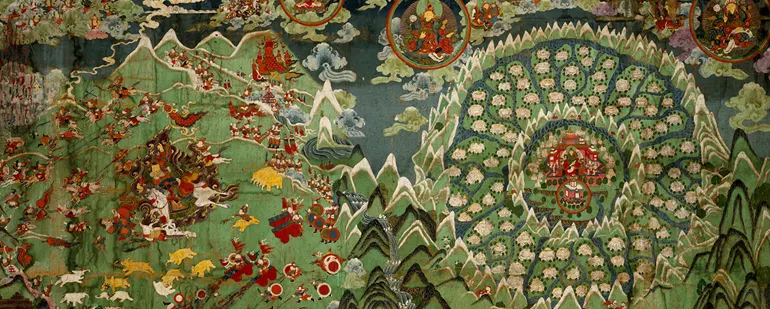
For centuries, the legend of Shambhala has captivated countless spiritual seekers, scholars, and explorers. Described as a hidden kingdom of peace, wisdom, and enlightenment, Shambhala holds a unique place in Tibetan Buddhism and Himalayan mythology.
According to ancient Buddhist texts, Shambhala is a spiritual kingdom that represents humanity’s highest potential in Tibetan Buddhist tradition. Its story originates from the Kalachakra Tantra, in which an enlightened king upholds sacred teachings until a harmonious future era arrives. The Bon scriptures speak of a closely related land called Tagzig Olmo Lung Ring. Over time, this mystical land has inspired countless interpretations, from religious prophecy to philosophical metaphors, and even ideals of a lost paradise.
Today, many believe that the spiritual source of Shambhala lies in the remote regions of Tibet and the Himalayas, where snow-capped peaks, sacred lakes, and pilgrimage routes continue to evoke a timeless pursuit of inner peace.
What is Shambhala?
Shambhala is an ancient concept originating from Hindu and Buddhist legends. The word Shambhala comes from Sanskrit, an ancient Indian language, and literally means “land of peace” or “land of tranquility.”
According to ancient legends, Shambhala is not an ordinary kingdom easily accessible to everyone. It is a mysterious and spiritual place, inhabited only by those with pure hearts and enlightened wisdom. Here, love and understanding are omnipresent, and people are free from the torment of disease, poverty, or old age. It is described as a land of kindness, peace, and spiritual fulfillment.
Shambhala has many different names in different cultures. Some call it the Forbidden Land, the Land of White Water, the Land of Radiant Spirits, or even the Land of Living Gods. In Chinese tradition, it is sometimes associated with the Western Paradise (Hsi Tien), and some ethnic groups in Russia also have their own names for it. Throughout Asia, however, the Sanskrit name Shambhala, or similar spellings such as Shambhala or Shangri-la, is most widely known.
What is the Shambhala Legend?
The story of Shambhala dates back thousands of years and is mentioned in various ancient texts. For example, Bon scriptures record a closely related holy site called Olmolungring; the Hindu Vishnu Purana describes Shambhala as the birthplace of Kalki, the incarnation of the last days, who will be led by believers into a new golden age. The Buddhist legend of Shambhala developed from the Hindu story, with the most detailed account found in the Kalachakra Tantra of Tibetan Buddhism.
In Tibetan Buddhism, Shambhala plays a central role in the Kalachakra Tantra, a sacred teaching on time, cycles, and spiritual growth. The text describes Shambhala as the abode of enlightened beings who preserve ancient wisdom. It also prophesies that in a future era of decline and conflict, a king from Shambhala, often called King Kalki or King Rigden, will appear, defeat the forces of darkness, and lead the world into a new era of peace.
Because Shambhala has never been found on a map, most people today consider it a mythical or spiritual symbol rather than a real place. For many believers, the story of Shambhala represents inner peace, spiritual awakening, and hope for a better future, rather than just a kingdom hidden in the mountains.
As stated in a Kalachakra initiation ceremony, Shambhala cannot be simply understood as a physical country that we can find. It is more like a “pure land in the human world,” which can only be experienced by those who have the corresponding merit and karmic affinity.
In Hindu scriptures such as the Vishnu Purana and the Srimad Bhagavatam, Shambhala is mentioned as the birthplace of Kalki, the ultimate avatar of Vishnu. According to these legends, Kalki will appear when the world is in chaos, bringing a new era of peace and justice.
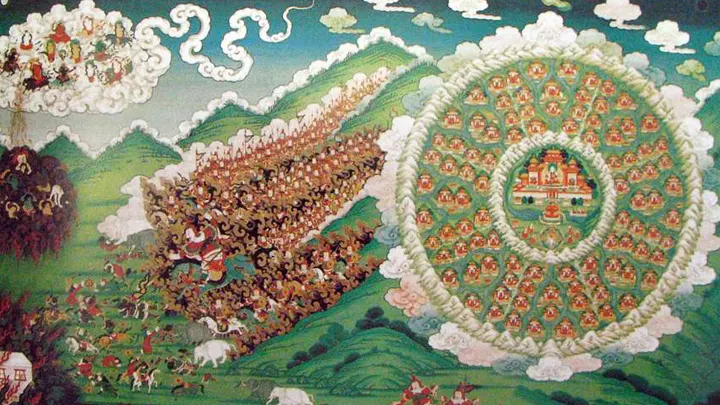
Is there a real place called Shambhala?
This question has lingered for centuries. The answer depends on how we interpret the legend. In traditional Tibetan Buddhist scriptures, Shambhala is described as a real kingdom with cities, rulers, and mountains. However, there is no historical or archaeological evidence to prove that Shambhala ever existed as an actual country. Nor are there any definitive maps or records showing its exact location.
In modern interpretations, Shambhala is generally understood as a spiritual symbol rather than a geographical location. It represents a state of inner awakening–a society guided by wisdom and compassion. From this perspective, Shambhala does not exist in the conventional sense, but rather as an ideal of enlightenment and harmony.
Some traditions believe that Shambhala is hidden in a remote region, found only by those who are spiritually prepared. Other traditions believe it exists within the human mind.
So, does Shambhala really exist? From a historical perspective, there is no evidence that it was ever a physical kingdom. But in the beliefs and practices of Tibetan Buddhism, it is considered real.
Is Shambhala the same as Shangri-La?
No, Shambhala and Shangri-La are not the same. The Shambhala legend is an ancient part of Tibetan Buddhist culture, recorded in religious texts over a thousand years ago. In these texts, Shambhala is a kingdom full of wisdom where people live according to spiritual laws. It is a place for meditation and seeking inner peace. Local Tibetans regard Shambhala as a sacred reality connected to their faith.
On the other hand, Shangri-La is a fictional place. British author James Hilton created the name for his 1933 novel Lost Horizon. He created a fictional valley based on the Shambhala legend. He imagined a hidden paradise that is eternally youthful. Although his book is widely popular in the West, the name Shangri-La does not exist in traditional Tibetan Buddhist scriptures.
The main difference is that the Shambhala legend focuses on spiritual growth and Buddhist teachings. Shangri-La is more like a romantic retreat far removed from the modern world. Today, a city in Yunnan Province has officially changed its name to Shangri-La to welcome tourists. If you want to find the original source of these stories, a wonderful Tibet trip allows you to experience the landscapes and traditions that gave birth to this timeless legend.
Where can you experience the spirit of Shambhala in Tibet?
While Shambhala is a spiritual land, many people can feel its presence when exploring the remote areas of western Tibet. Two places perfectly embody the essence of this legend.
Mount Kailash: the Center of Tibetan Buddhism
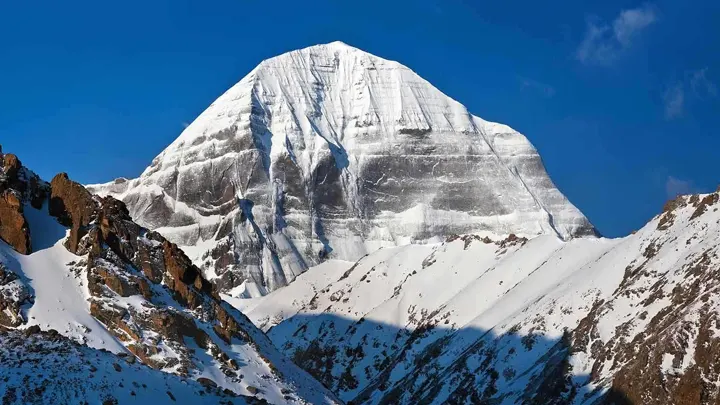
Although Shambhala itself is a mythic kingdom described in Buddhist texts, sacred sites such as Mount Kailash reflect the spiritual atmosphere that inspired the legend. This mountain is unique, with steep sides resembling a natural pyramid. For over a thousand years, followers of four different religions have come here to perform the “Kailash Kora,” which is a 54-kilometer trekking route that circles the foot of the mountain. Historians and researchers of Tibetan culture often look at the Ngari Prefecture when they study the Shambhala Legend. They point out that the mountain’s remote location, depicted as a spiritual “axis” in ancient maps, may be the reason for the existence of the Shambhala kingdom. When you come here, you can appreciate the high-altitude terrain and specific landmarks described in religious texts as symbolizing the boundaries of the sacred kingdom.
Guge Kingdom: the Lost Empire
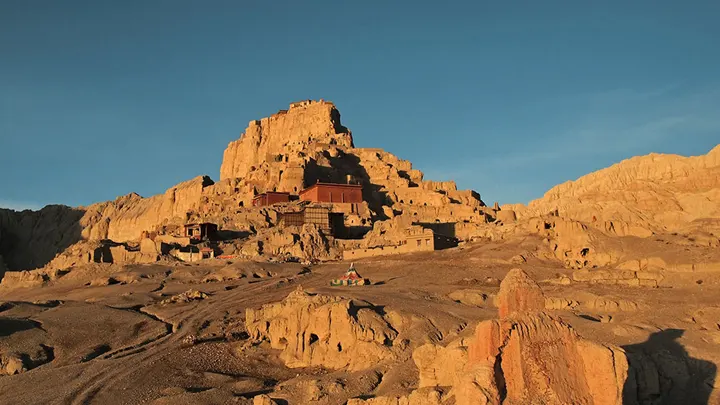
If you want to see a true “hidden kingdom,” the ruins of the Guge Kingdom are undoubtedly the best place to go. This ancient civilization vanished centuries ago, leaving behind only stunning mud-brick palaces and temples on steep mountain slopes.
Founded in the 10th century AD, this kingdom lasted for about 700 years. It was a vital center for the spread of Buddhism and trade between Tibet and India. Today, the ruins comprise a vast network of caves, palaces, and monasteries, all built directly onto a clay mountain.
The ruins are divided into different levels. The common people lived in over 400 caves at the foot of the mountain, while royalty and monks resided in palaces at the top of the mountain. In the existing temples, primitive murals and silver statues dating back centuries can still be seen. These sites provide physical evidence of a highly organized society, demonstrating its isolation from the outside world. Because it was long concealed by the arid “earth forest” landscape, many historians use Guge as an example to explain the origins of the Shambhala legend.
Practical Tips for Your Tibet Trip
Foreign tourists traveling to Tibet need a Tibet Travel Permit in addition to a Chinese Tourist Visa. If you plan to visit western Tibet, such as Mount Kailash and Lake Mansarovar, you will also need an Aliens’ Travel Permit and a Military Area Entry Permit. Our travel agency handles all these documents. You only need to send us copies of your passport and visa at least 30 days before departure.
Besides, the Ngari Prefecture has a high altitude, averaging over 4,500 meters. Therefore, most tourists will stay in Lhasa for a few days to allow their bodies to acclimatize to the thin air. We recommend avoiding strenuous exercise for the first two days of your trip. While physical health is important, maintaining a calm mindset will also help you better adapt to altitude sickness.
Conclusion
The legend of Shambhala is an important part of Tibetan culture, helping us understand the history and natural scenery of this land. While we may not find a magnificent palace in the mountains, the tranquility and wonder of western Tibet are undeniable.
Visiting places like Mount Kailash and the Guge Kingdom will give you the opportunity to trace the roots of these ancient traditions. You can experience the serene beauty of the plateau firsthand and witness the history of a lost civilization. Every traveler finds different insights in Tibet; perhaps you too can find your own Shambhala on your journey.


